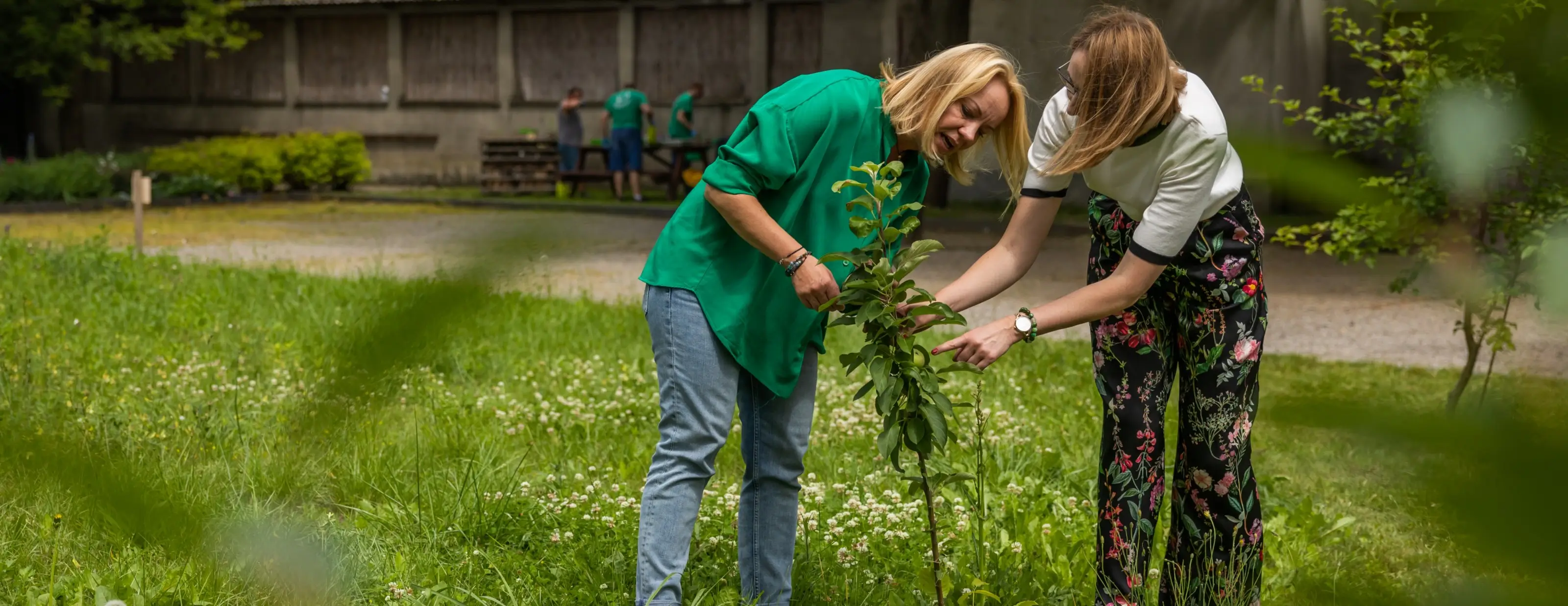
Green – Competitive – Inclusive
Image credits: Archiwum WTZ w Śremie(PL)
Investing in a greener, more competitive and more inclusive Europe to strengthen long‑term stability and shared prosperity across the region.
A framework for sustainable development
The EEA and Norway Grants support Beneficiary States in addressing Europe’s interconnected environmental, economic and social challenges. During the 2014–2021 funding period, the Grants concentrated on three overarching themes: Green Europe, Competitive Europe and Inclusive Europe. These priorities reflected the need to accelerate climate action, strengthen economic opportunities and ensure that all people can participate fully in society. Together, they provided a coherent framework for targeted investments that improved environmental protection, supported innovation and job creation and expanded access to essential services. As democratic pressures grew across Europe, the Grants later complemented these themes with an explicit focus on safeguarding democratic values.
Green Europe: Protecting the planet and promoting sustainability
Environmental sustainability was a core element of the EEA and Norway Grants during the 2014–2021 funding period, reflecting the central role of environmental protection in Europe’s long‑term economic stability, public health and social well‑being. Under the Green Europe priority, support addressed climate change mitigation and adaptation, sustainable resource management and the protection of ecosystems, while contributing to more resilient and competitive economies in Beneficiary States.
Investments took many forms. A significant focus was placed on reducing dependence on fossil fuels through improved energy efficiency and increased use of renewable energy. Projects supported geothermal energy, solar power, biomass and energy‑saving measures, often combining infrastructure investments with training and capacity building. In several programmes, cooperation with Donor-state partners strengthened technical expertise and helped adapt solutions to local conditions. Support for innovative energy management tools also improved planning and efficiency in national energy systems, aligning environmental objectives with economic performance.
Alongside energy‑related measures, the Grants supported the transition towards a circular economy. Pilot initiatives promoted waste reduction and recycling, demonstrating how environmental innovation can inform policy development and contribute to more sustainable consumption patterns. These actions reinforced Beneficiary States’ ability to meet environmental commitments while integrating green solutions into broader development strategies.
Protecting biodiversity and natural ecosystems was another key dimension. Projects addressed environmental risks such as flooding, habitat degradation and marine pollution through restoration of wetlands, sustainable tourism management and research into alternative materials. Many initiatives combined environmental protection with community engagement, education and awareness raising, recognising that lasting impact depends on informed and active citizens.
Across the funding period, Green Europe projects strengthened institutional and technical capacity, encouraged innovation, and fostered cross‑border cooperation. By targeting both policy frameworks and practical solutions, the EEA and Norway Grants helped Beneficiary States move towards greener, more resilient development while protecting ecosystems and improving quality of life for communities.

The EEA and Norway Grants in numbers
| Overview |
|---|
| 3 Programme Areas |
| 15 Programmes |
| 12 Beneficiary States |
| 763 Projects |
| 42% of projects with Donor project partner |
| Indicator | Target | Achievement |
|---|---|---|
| Energy produced from RES (in MWh/year) | 86,515 | 735,059.7 |
| Estimated annual CO₂ emissions reductions | 978,716.39 | 524,499.6 |
| Installed capacity for production of renewable energy (in MW) | 34.89 | 77.72 |
Project example

Once upon a time there was a wetland
In Slovakia’s Morava River region, the “Wetlands for life and well-being” project aimed to reverse centuries of ecological degradation. Once rich in biodiversity, the wetlands had been drained, converted to farmland, and altered by river regulation. With support from the Norway Grants, Slovak conservation experts and the Norwegian Institute for Nature Research are restoring more than 210,000 m² of degraded wetland into species-rich and sandy alluvial meadows.
The project removed invasive species, re-established natural water dynamics, and created vital habitats for protected plants and migratory birds. By reviving these ecosystems, the initiative strengthened climate resilience, enhanced carbon storage and demonstrated how wetland restoration can deliver lasting environmental benefits.
Competitive Europe: Driving innovation and economic growth
Economic growth, innovation and employment are central to Europe’s resilience and long‑term prosperity. During the 2014–2021 funding period, the EEA and Norway Grants supported competitiveness as a key component of sustainable development, helping Beneficiary States strengthen their economies while responding to a rapidly changing and increasingly uncertain context. The acceleration of the green and digital transitions, recovery from the COVID‑19 pandemic, rising prices, and disrupted supply chains all underscored the need for resilient and adaptable economic systems.
Under the Competitive Europe priority, the Grants focused on boosting innovation capacity, enhancing skills and knowledge, and fostering entrepreneurship. Investments targeted human capital, research‑driven development, and technology, recognising that well‑prepared and skilled populations are essential for sustainable economic growth. Particular emphasis was placed on youth employment, training and entrepreneurship, helping to address structural labour market challenges and support future‑oriented skills.
Support for private enterprises, especially SMEs, was a core element of this approach. Open and competitive calls ensured transparency and fair access to funding, while co‑financing requirements leveraged private investment and encouraged ambition. These measures stimulated job creation, innovation and the uptake of sustainable and digital solutions, strengthening local and regional economies across Beneficiary States.
Competitiveness was also pursued through stronger institutions and sound economic governance. Programmes supported more efficient and effective public institutions, including judicial systems, recognising that predictability, rule of law and institutional trust are prerequisites for investment and innovation. Social dialogue and promotion of decent work further contributed to inclusive and balanced growth.
Bilateral cooperation between Donor and Beneficiary States reinforced these efforts by enabling knowledge exchange, skills development and research collaboration. Across the funding period, this integrated approach to competitiveness helped build a more resilient economic landscape, better equipped to adapt to global challenges while supporting sustainable, inclusive growth.

The EEA and Norway Grants in numbers
| Overview |
|---|
| 11 Programme Areas |
| 33 Programmes |
| 14 Beneficiary States |
| 1,938 Projects |
| 60% of projects with Donor project partner |
| Indicator | Target | Achievement |
|---|---|---|
| Estimated annual CO2 emissions reductions | 423,000 | 198,337.84 |
| Number of jobs created | 5,159 | 4,545 |
| Number of new products/technologies developed | 371 | 697 |
| Number of researchers supported | 2,270 | 5,133 |
| Number of SMEs supported | 884 | 2,852 |
| Number of young people aged 15-29 completing vocational education or work-based learning | 19,079 | 23,791 |
Project example

Women in leadership
The Promova programme in Portugal is a leadership initiative designed to accelerate gender equality in senior management. Through Norway Grants support, the project offered intensive training, mentoring and professional development for women across sectors, helping strengthen leadership pipelines and address persistent gender gaps in decision-making. Promova participants gained new managerial skills, expanded professional networks and increased their visibility within organisations. Early results show strong career progression among alumnae and growing employer interest in more inclusive leadership cultures. By equipping women with tools to lead and by engaging companies in structural change, Promova contributed to a more innovative, competitive and equitable economy.
Inclusive Europe: Strengthening equality and social cohesion
Inclusion was a defining objective of the EEA and Norway Grants during the 2014–2021 funding period, grounded in the understanding that sustainable development depends on fair access to rights, services and participation. A truly inclusive Europe is one in which all people can take part in civic, social and economic life, and where institutions respond to diversity, vulnerability and inequality. The Grants therefore combined social inclusion measures with actions to strengthen democratic institutions and civil society.
Support focused on improving access to education, healthcare and social services for groups at risk of exclusion, including women, children, ethnic minorities such as Roma, people with disabilities, and victims of domestic and gender‑based violence. Programmes addressed poverty reduction, work‑life balance, gender equality and protection from violence, responding to differing national needs and levels of socio‑economic development. During the COVID‑19 pandemic, when risks of exclusion and violence increased, this support proved particularly critical.
Civil society organisations played a central role in delivering services, advocating for rights and reaching communities that public institutions struggled to serve alone. Capacity building strengthened their ability to engage in policy dialogue, coordinate across sectors and sustain their work. At the same time, the Grants supported local and national authorities in improving governance, coordination and compliance with international human rights standards, helping translate rights into tangible outcomes.
As the funding period progressed, growing concerns about shrinking civic space, declining trust in institutions, and barriers to access to justice highlighted that inclusion cannot be achieved without strong, open and accountable democratic systems. The Grants therefore also supported improved access to justice for vulnerable groups, strengthened rule of law, and measures to enhance transparency, participation and information integrity. Actions under the Active Citizens Fund reinforced civic engagement, alliance building, and advocacy, ensuring that marginalised voices could shape public debate and policy.
By linking social inclusion with democratic participation and institutional strengthening, the Grants helped build fairer systems, more accessible services and more resilient communities. Inclusive Europe thus advanced equality and social cohesion while anchoring inclusion firmly in the rule of law and democratic governance.

The EEA and Norway Grants in numbers
| Overview |
|---|
| 11 Programme Areas |
| 49 Programmes |
| 14 Beneficiary States |
| 3,963 Projects |
| 25% of projects with Donor project partner |
| Indicator | Target | Achievement |
|---|---|---|
| Annual number of cases of domestic and gender-based violence officially reported | 91,602 | 132,129 |
| Number of national policies and laws influenced | 323 | 1,346 |
| Number of people reached by campaigns | 18,587,000 | 203,841,528 |
| Number of students educated in civic and human rights | 25,270 | 60,072 |
| Number of unaccompanied asylum-seeking minors receiving services | 3,650 | 3,574 |
| Number of vulnerable individuals reached by empowerment measures | 40,310 | 1,268,265 |
Project example

Child-friendly justice system in Latvia
Latvia’s first Barnahus is transforming how authorities respond to child abuse. Supported by the Norway Grants, the project brings police, social workers, psychologists and medical experts together under one roof to ensure that children are interviewed only once, in a safe and supportive environment. This coordinated model reduces trauma, speeds up investigations and improves access to specialised care. The Latvian Barnahus has already strengthened cooperation across institutions and raised professional standards in child protection. By putting children’s rights at the centre of the justice process, the project helps create a more inclusive, protective system for young victims.
Why these goals matter
- Green Europe responds to the urgent need for climate action, environmental protection and disaster resilience, securing a sustainable future for both people and economies.
- Competitive Europe builds the foundations for long-term economic growth, job creation and innovation, equipping societies to adapt to technological, demographic, and market changes.
- Inclusive Europe ensures fairness, equality and social cohesion, empowering vulnerable groups and fostering strong, democratic societies.
Together, these priorities reflect Europe’s commitment to sustainable development, resilient economies and equitable societies. The EEA and Norway Grants strengthened institutional capacities, promoted knowledge exchange and encouraged bilateral cooperation to address shared challenges. By integrating environmental, economic and social objectives, the Grants contributed to a Europe that is greener, more competitive, and more inclusive for all citizens.